ArtFundMe / Editorial
Alex Singleton (Asbirdman) — Artist Interview
Oxford mural artist Alex Singleton, also known as Asbirdman, on humour in public art, a Danse Macabre house commission, community workshops, printmaking and advice for a first outdoor wall.
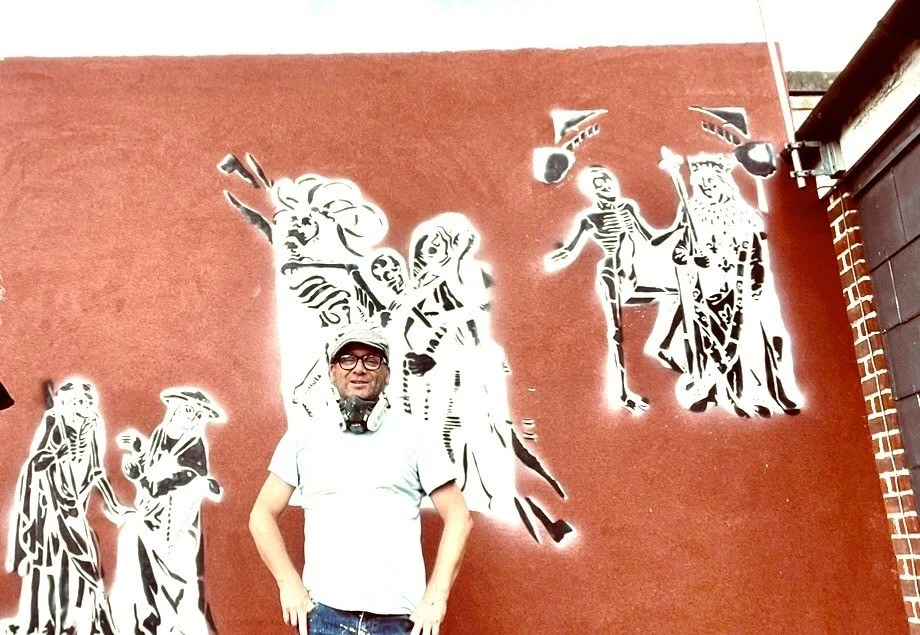
Alex Singleton, also known as Asbirdman, is an Oxford-based mural and street artist whose practice moves between walls, workshops, printmaking and canvas. In this interview he talks about how a wall tells him where to begin, why humour and character matter in public space, one Oxford commission that grew from market linocuts into a lasting collaboration, community workshops, painting in other cities, and advice for anyone facing their first large outdoor wall.
What does a wall need to tell you before you start painting?
The first thing a wall needs to tell me is, “Can you reach me?” Do I need a simple stool, an extension pole, a ladder, or even scaffolding? These practical considerations are always the starting point.
The next question is, “Where does my design begin?” I look at the space and try to find that first point of connection between the image and the wall. Once I’ve established where to start, I find that the rest of the mural naturally begins to fall into place. There’s something quite instinctive about the process. Once I’ve made that first mark, the wall and the painting begin to have a conversation of their own.
How do humour and character help a mural speak to people who may never enter a gallery?
Humour is incredibly important to me. Many mural artists create beautifully finished, almost perfect images, and there’s absolutely nothing wrong with that. But I’m interested in something that makes people stop, smile and then take a second look.
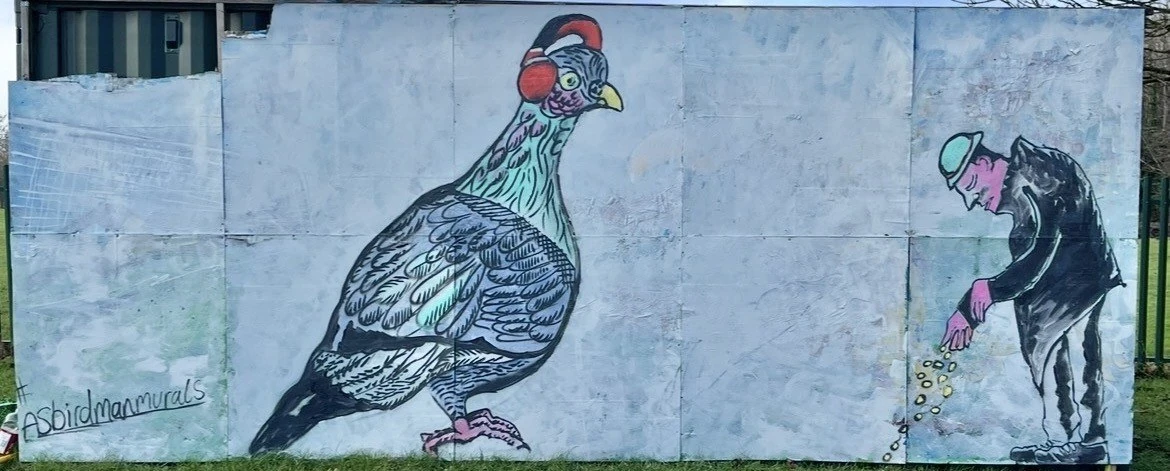
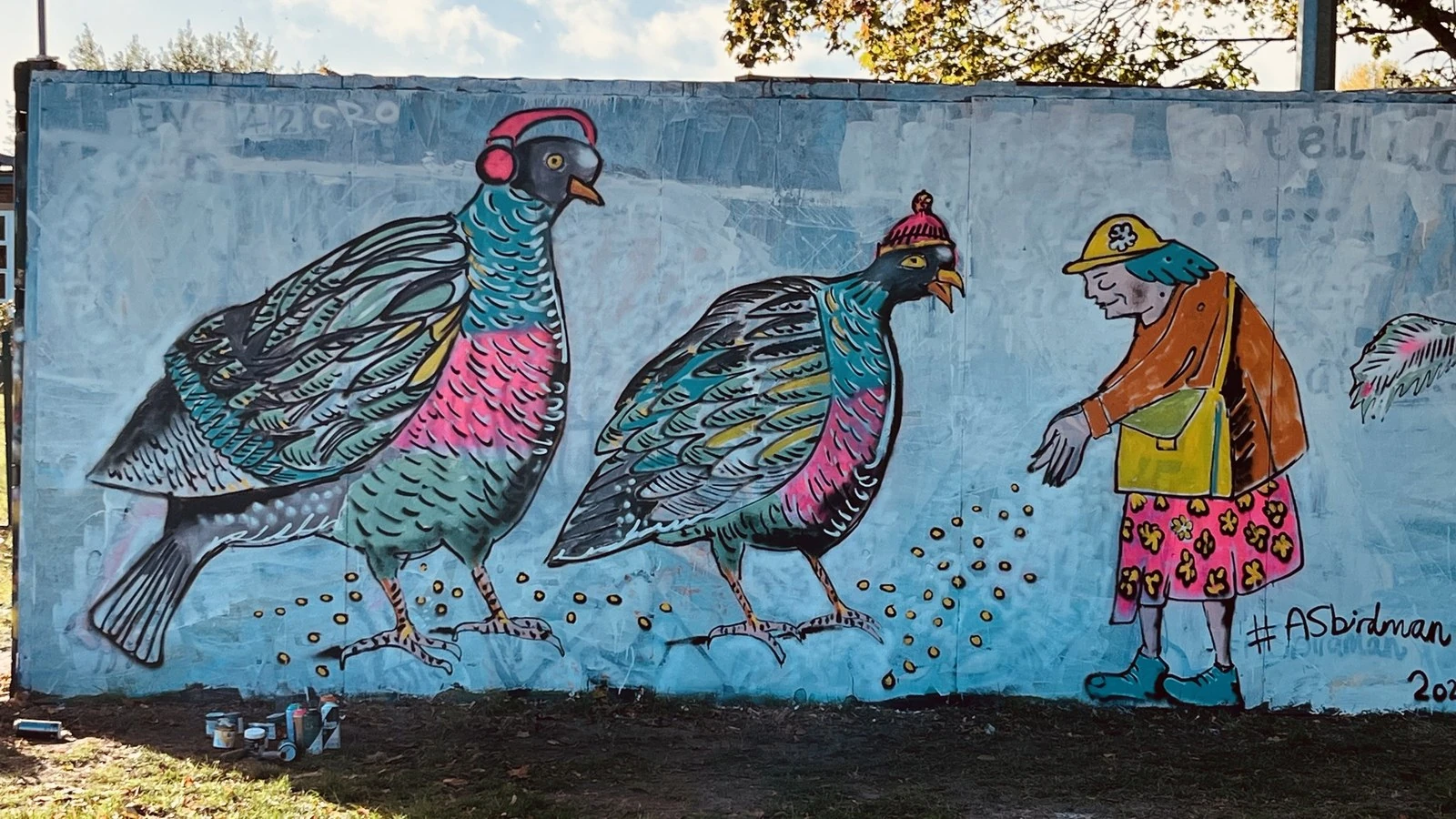
For example, in my giant pigeon murals, the person feeding the pigeon is much smaller than the bird itself. Suddenly, the ordinary relationship between humans and pigeons is reversed. The pigeon becomes the dominant character, almost as if it has taken on a cheeky authority over the human in an otherwise familiar park setting.
I also like to use loose, sketchy lines, rather like the drawings you might find in a newspaper cartoon. They give the image movement, energy and a sense of spontaneity.
I sometimes feel that when an image is too perfect, there’s very little left for the imagination to do. I like to leave something for the viewer’s brain to work out, something slightly absurd or unexpected. That moment of trying to make sense of what you’re seeing is part of the enjoyment. And humour is a wonderful way of reaching people, whether or not they have any particular interest in art.
Can you describe the process behind one Oxford mural that meant a lot to you?
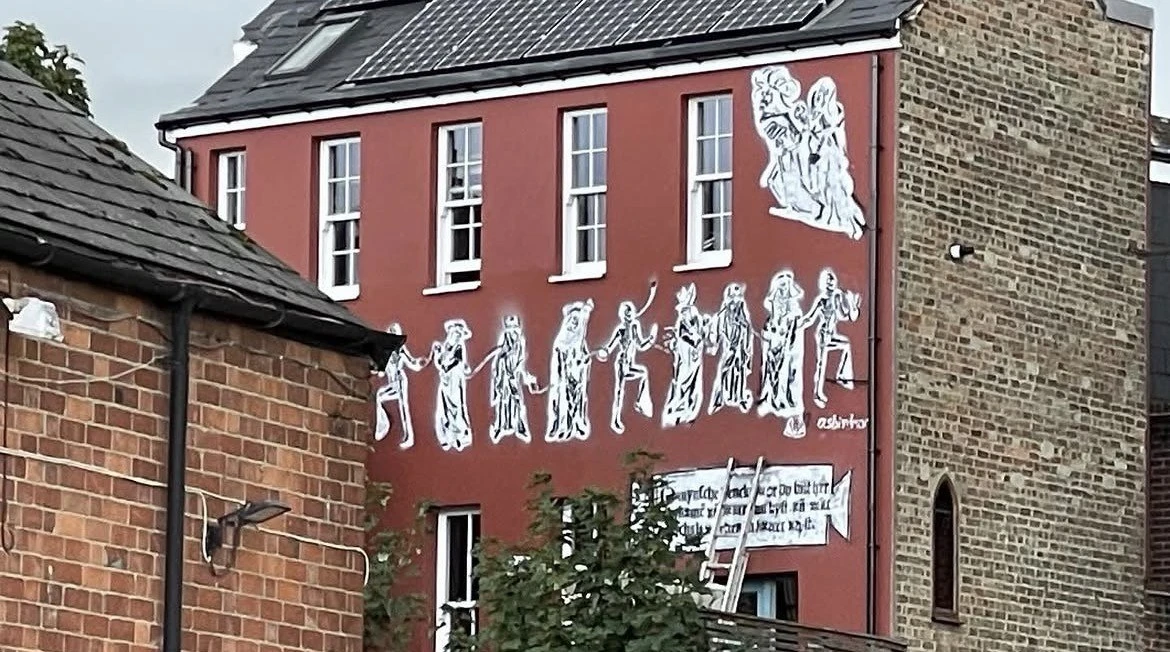
One of my most unusual and enjoyable commissions came from an Oxford professor of medieval German studies. She had discovered my linocut-printed cards, which I was selling at local markets, and asked me to paint the exterior of her house.
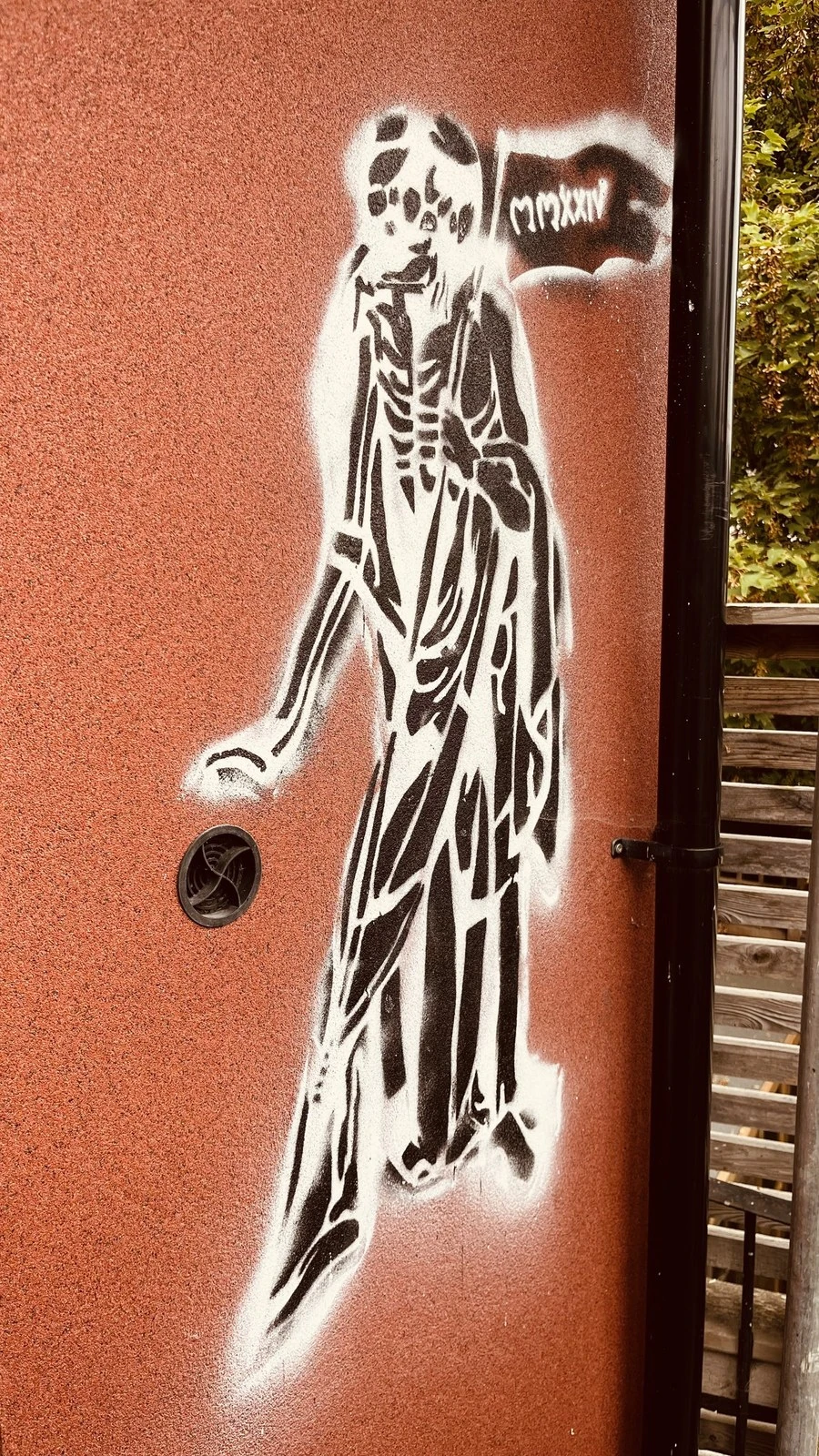
The subject she chose was the Danse Macabre, or Dance of Death, a medieval theme that reminds us that death makes everyone equal. Whether you’re a serf, a priest, a merchant or a king, we all eventually reach the same destination. In the end, we become dancing skeletons, stripped of our wealth, status and social importance. I love the mixture of humour, history and social commentary in this idea.
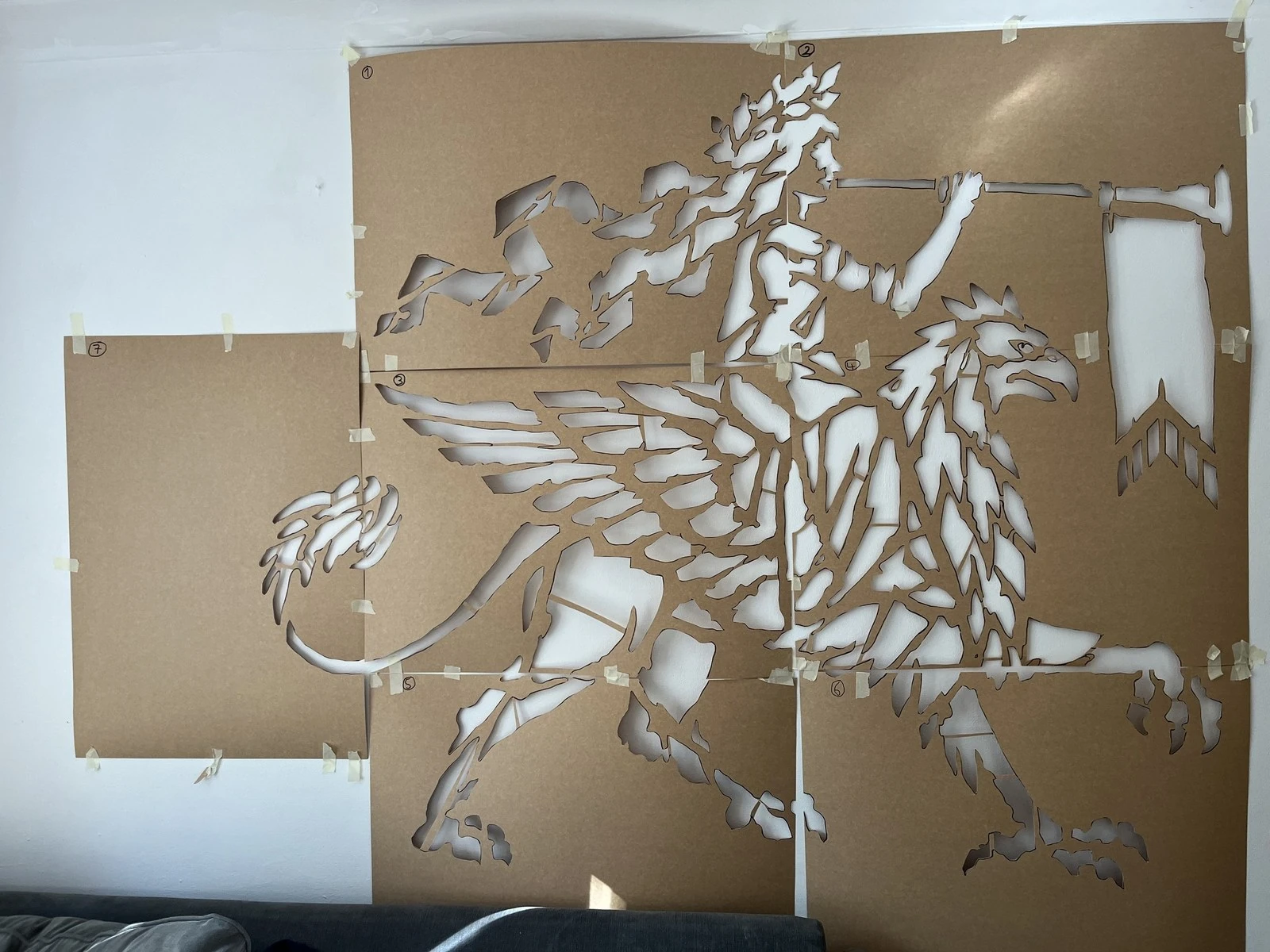
To create the mural, I took my original linocut designs and enlarged them using a projector, cutting stencils from Manila card to transfer the images onto the walls. It was a fascinating way of taking something originally made as a small print and transforming it into a much larger public-facing work.
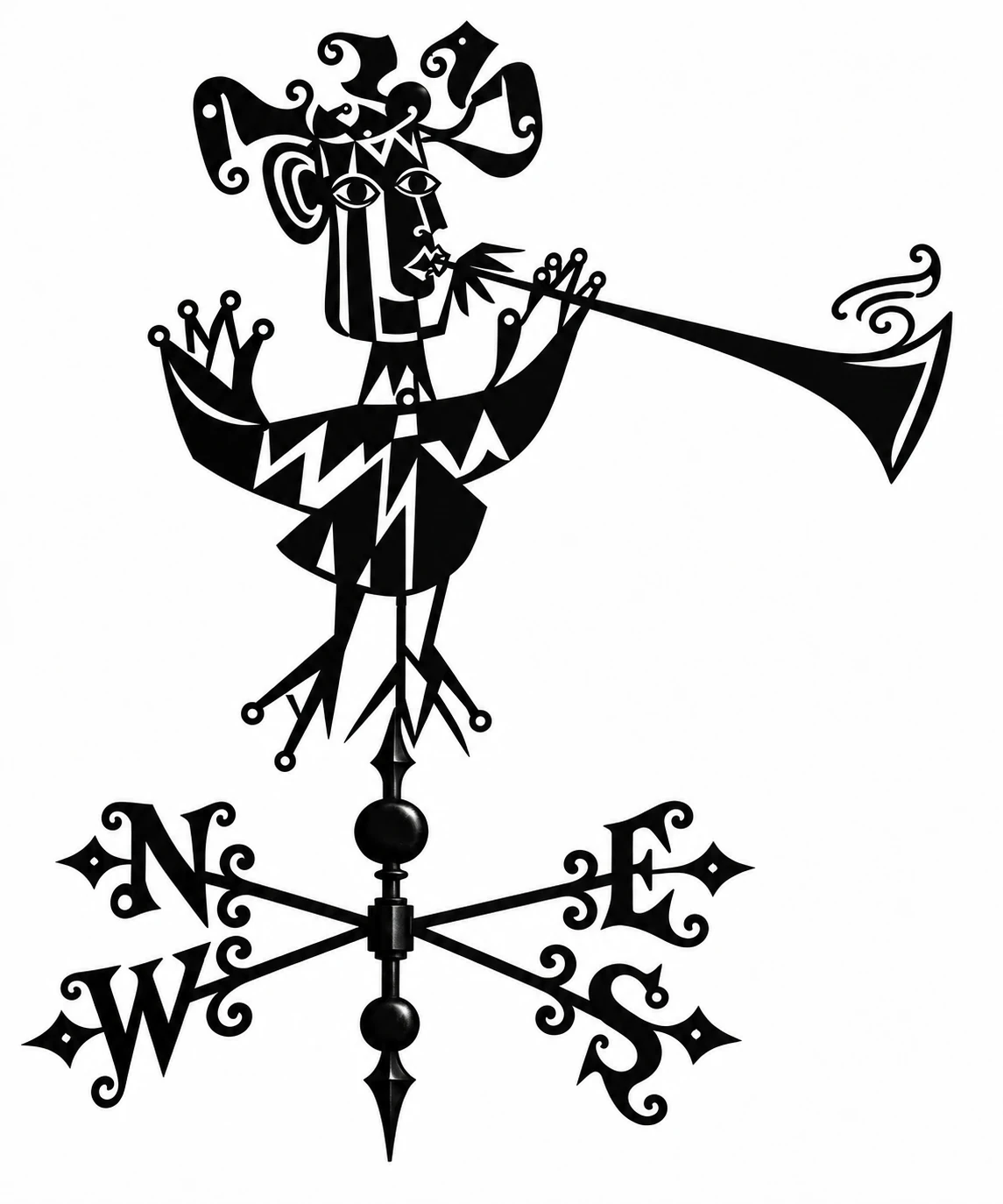
The professor has continued to commission me over the years, particularly for projects inspired by medieval German history and imagery. More recently, I created new images for her house based on the procession of Emperor Maximilian I, and I also designed a weathervane for her roof influenced by the wonderful, playful work of Paul Klee.
What makes this commission special to me is the freedom to explore history, humour and printmaking together, and the way one small encounter at a market developed into a lasting creative relationship.
How do workshops with communities or schools change what ends up on the wall?
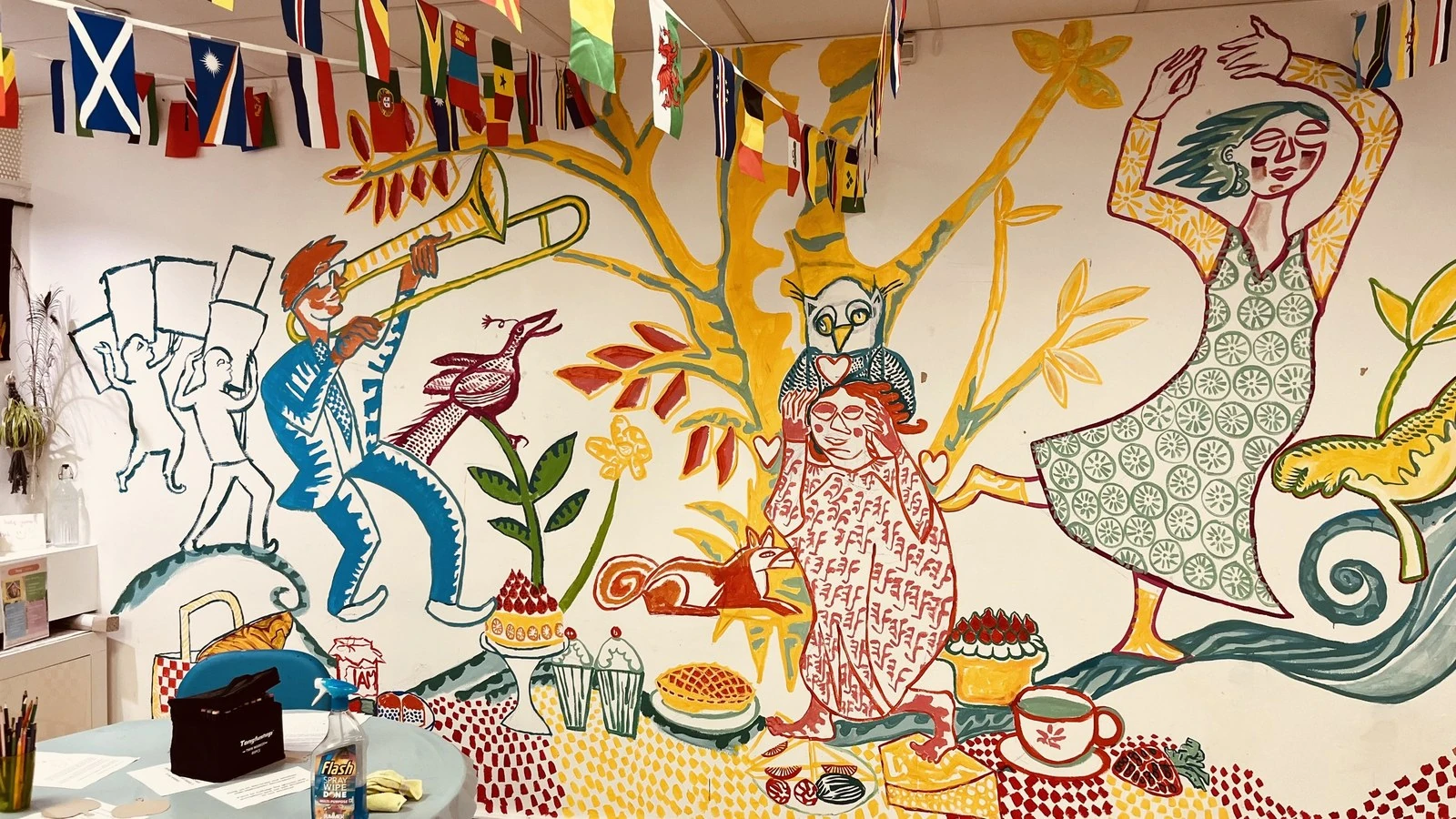
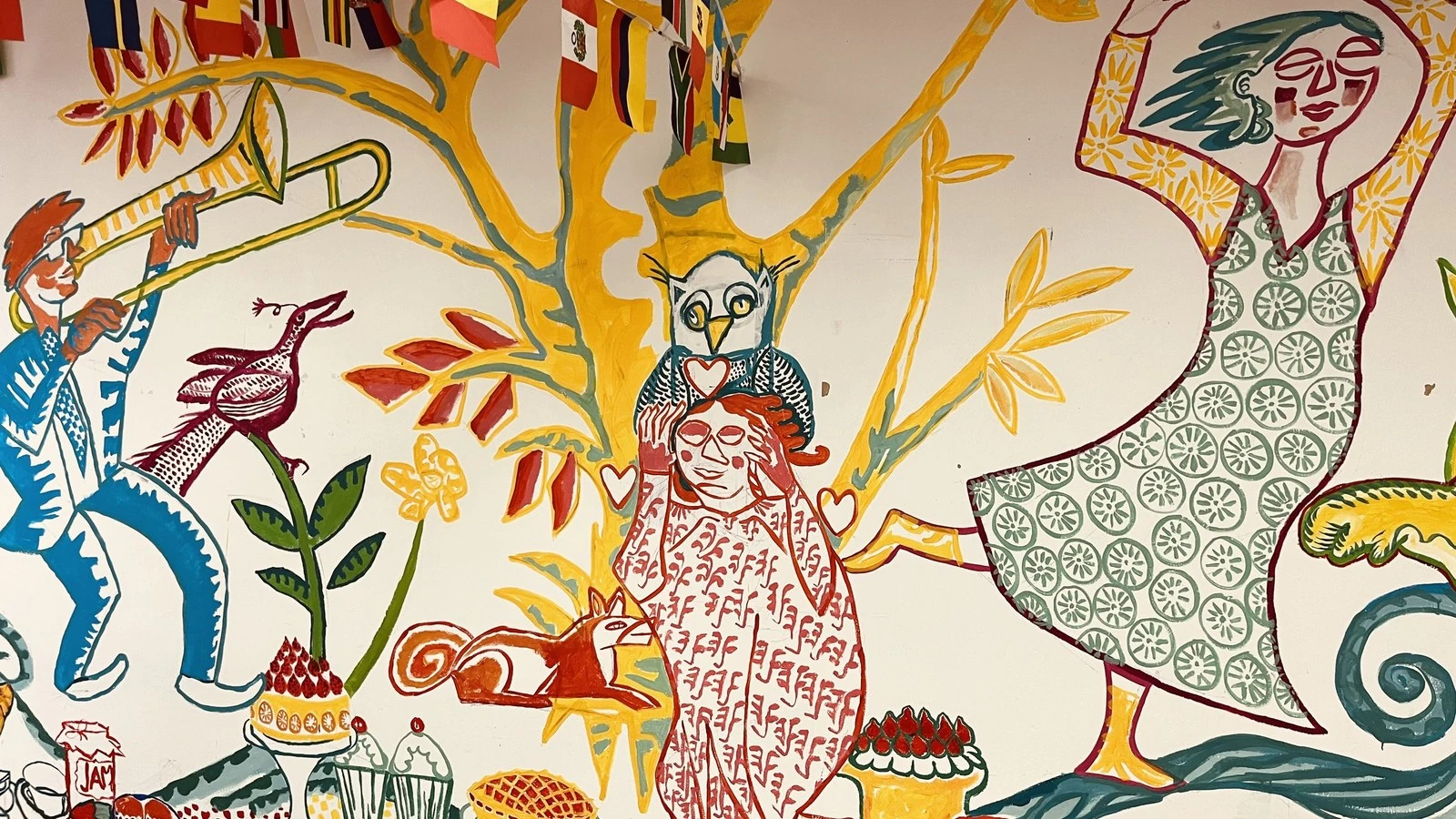
Recently, I created a mural with Ark-T, a community arts charity, at the Temple Cowley Shopping Centre in Oxford. This was a particularly rewarding experience because the mural wasn’t simply something I designed and painted for people. It was something we created together.
We began by sitting down as a group, discussing ideas and writing down what everyone would like to see in the mural. From there, I worked out how to bring those different ideas together and gave people individual sections to paint.
I also wanted to leave room for people to express their own thoughts. I painted figures holding placards, but left the placards blank so that participants could add their own words and messages. In this way, the mural became a place for people’s voices as well as their artwork.
The project took several weeks because everyone came in on different days. What I found particularly wonderful was seeing people who had never painted before become enthusiastic about joining in. Others simply stopped to talk, ask questions or share what the mural meant to them.
I think we sometimes forget how important these community spaces are. People come for all sorts of reasons. Some are retired, some are lonely, some have lost a partner, some are out of work, and others simply want a bit of company and conversation.
Art can bring people together without demanding anything from them. You don’t have to be an artist to take part. Sometimes just being there, chatting and feeling included is as important as the painting itself.
For me, that’s one of the most valuable things about community murals. The finished image is important, but the conversations, friendships and unexpected contributions that happen along the way can be just as meaningful.
What have you learned from painting in different cities that still shapes the Oxford work?
Painting in different cities has taught me that every place has its own character, social structure and attitude towards public art.
Some cities feel more egalitarian, while others are more concerned with status, work and established institutions. Some have a strong sense of independence from mainstream culture, and that can make a huge difference to the art you encounter on their streets.
Bristol, for example, has a wonderful history of counterculture. Alternative living, squatting, protest and the freedom to think independently have all played a part in shaping its creative identity. There’s a feeling that art doesn’t always have to be about money or official approval. It can be about questioning society and making your own voice heard.
Oxford feels quite different. It is a much more hierarchical city, where the university has an enormous influence over its identity. There is an alternative culture here, of course, but it often exists alongside very visible class boundaries and the pressures of money and privilege.
Melbourne was another fascinating experience. I had a few difficulties while painting there, including people taking my paints, but what really struck me was the extraordinary amount of street art. From the outer suburbs right into the centre, there seemed to be an explosion of colour and creativity. It felt as though hardly a wall had been left untouched.
These experiences have made me much more conscious of the relationship between art and the people who live around it.
In Oxford especially, I’ve learned that you have to be sensitive to the community you’re working in. Public art belongs to the people who encounter it every day, and if something feels imposed upon them or out of place, people can become upset quite quickly.
I think it’s important to understand a neighbourhood before trying to put your mark on it. A mural should have some sort of relationship with the people and the place around it, even when it’s humorous, strange or unexpected.
How do printmaking and canvas pieces sit beside the public murals?
Printmaking is a very important part of my street art practice. In many ways, the two are closely connected.
I often begin with a linocut or letterpress design, something relatively small and intimate, which I then enlarge to poster size. The enlarged image can be printed in sections and pasted onto a wall using ordinary wallpaper paste. The separate pieces come together to form a much larger image.
Sometimes a painting I’ve created on canvas will also develop into an idea for a street mural. I enjoy the way an image can move between these different forms, changing its scale and character as it goes.
There’s something exciting about taking an image that began on a small piece of paper or canvas and placing it in a public space, where it becomes part of the street and everyday life.
Of course, the physical process is very different from sitting in front of an easel. Working outdoors can involve ladders, scaffolding, cutting stencils, carrying materials, dealing with the weather and all sorts of unexpected interruptions.
It’s often far more physically demanding and unpredictable, but that’s part of what makes it interesting. I like the challenge of adapting an idea to a completely different environment.
What advice would you give an artist attempting their first large outdoor wall?
My advice would be to get out there and talk to the artists who are already working on the streets. Ask questions, watch how they work and, if the opportunity arises, ask whether you can join in and help.
You can learn an enormous amount simply by watching someone else prepare a wall, scale up a design or work out the practical problems of painting outdoors.
Street art festivals are another brilliant way to begin. Often, each artist is given a section of wall to work on, and there’s a real sense of people learning from one another, sharing ideas and exchanging techniques.
I think learning by doing is essential. You can spend a long time planning something, but you learn so much more when you actually get in front of a wall and start painting.
And perhaps most importantly, stay in touch with the people you meet. Networking, friendships and supporting other artists are a huge part of street art culture. Opportunities often come from conversations and connections rather than formal applications.
Don’t be too worried about getting everything perfect. Have a go, make mistakes, learn from other people and enjoy the experience. The confidence comes with doing it.
Gallery
Portrait and selected works by Alex Singleton (Asbirdman), shared for this interview.